


Cheap Houses in Japan: Prices, Real Costs & Where to Buy

Cheap houses in Japan can cost as little as ¥500,000 (about $3,200 USD). Some akiya (空き家, vacant homes) even list for free. Japan has about 9 million akiya, or 13.8% of all homes, according to the 2023 Housing and Land Survey.
Foreigners can buy property in Japan with no visa or residency requirement. But the asking price is rarely the real cost. Agent fees alone can reach ¥330,000 on a house priced at ¥8 million or less.
This guide shows what each budget buys and where to find listings on akiya banks. It also shows what a cheap house really costs to buy and own in 2026.
How to find cheap houses for sale in Japan
First, you must know how to find a cheap house in Japan. With the right resources, you might even find a free house.
Cheap house prices in Japan by region and budget
Budget (JPY) |
About (USD) |
What you typically find |
Where to look |
Renovation to expect |
|---|---|---|---|---|
¥0–500,000 |
$0–3,200 |
Abandoned akiya, often partly furnished, with old wiring and plumbing |
Rural Hokkaido, Tohoku, Shikoku, mountain villages |
¥3M–15M+ |
¥500,000–3M |
$3,200–19,000 |
Older wooden houses, many built before 1981 |
Rural towns and small cities |
¥3M–10M |
¥3M–8M |
$19,000–51,000 |
Habitable older homes in fair condition |
Regional cities, commuter towns near Osaka and Nagoya |
¥1M–6M |
¥8M–15M |
$51,000–95,000 |
Move-in-ready houses, some recently renovated |
Western Tokyo (Tama area), suburbs of Kyoto and Osaka |
Light work |
Prices are approximate, at about ¥158 per USD (October 2026). As of 18 September 2026, Akiya Japan listed 16,094 houses under $50,000, with a median asking price of ¥3,900,000. Most were built between 1956 and 1990.
a. Akiya banks
Akiya banks (空き家バンク, akiya banku) are listing sites for vacant homes. Most are run by local governments, so prices often sit below regular real estate listings. Many of these houses are abandoned and need work.
Popular English-language options for foreigners include:
Akiya & Inaka : rural listings, bilingual brokerage support, and an email newsletter
Akiya-Mart: curated listings with prices in USD and JPY
Akiya Japan: map search across all 47 prefectures, updated daily
Akiyaz: an English akiya platform we interviewed
Municipal akiya banks: search the town name plus 空き家バンク for local listings in Japanese
Good deals can move fast. Subscribe to two or three newsletters, and check the listing date and photos on each property. Some municipal programs also require buyers to live in the town.
b. Real estate agents
Real estate agents can find akiya houses for sale in Japan that never reach akiya banks. An agent who specializes in cheap akiya can help you find a dream home faster. They also handle paperwork, negotiation, and translation.
Know the fee before you sign. Since 1 July 2024, agents may charge up to ¥330,000 including tax on a property priced at ¥8 million or less. On a ¥500,000 house, that fee equals 66% of the price.
The agent must explain this fee and agree on it with you before you sign the brokerage contract. It is a cap, not a fixed price, so you can negotiate.
Ask for the fee in writing, and compare at least two agents.
Why are houses in Japan so cheap?
Cheap houses exist in Japan for three main reasons.
1. Buildings lose value fast. Japan's tax rules give wooden houses a useful life of 22 years. After that, the building has almost no book value, so banks rarely lend against it. Read more in our guide to Japan housing depreciation.
2. People are leaving rural areas. Japan's population peaked at about 128 million in 2008. The preliminary 2025 Census counted 123,049,524 people, and 90.6% of municipalities lost residents.
3. Japanese buyers prefer new homes. Most people want a new build rather than an older house. So older homes, even ones in good condition, can sit unsold for months or years.
How to buy a cheap house in Japan in 6 steps
Buying a cheap house in Japan follows the same steps as any real estate purchase. Most cheap houses are bought in cash, since banks rarely offer a loan to foreigners on old buildings.
Set a total budget. Add the price, fees, taxes, and renovation, using the worked example below.
Find listings. Use akiya banks, English platforms, and local real estate agents.
Visit and inspect. Book a home inspection and check zoning rules. Some lots cannot be rebuilt (saikenchiku fuka, 再建築不可). Their land does not touch a legal road at least 4 meters wide for at least 2 meters.
Review and sign. Before you sign, a licensed real estate transaction specialist (takken-shi, 宅建士) explains the important matters explanation (juyo jiko setsumei, 重要事項説明). It must state if the house cannot be rebuilt.
Pay and register. A judicial scrivener registers the house in your name at the Legal Affairs Bureau.
File reports and set up. Non-residents must report the purchase within 20 days, even for a ¥0 house. Then appoint a tax representative and set up utilities.
For the full process, read how to buy a house in Japan as a foreigner.
What to know before buying a cheap house in Japan
1. Visa status
Buying a house in Japan does not give you a visa. Your residence status decides how long you can live in it. Read can I live in Japan if I buy a house? for the full answer.
Easiest: permanent residents and spouse visa holders can live in the house full time.
Visitors: many nationalities can stay up to 90 days at a time without a visa.
Business owners: since 16 October 2025, the Business Manager visa needs ¥30 million in capital and at least one full-time employee.
Remote workers: the digital nomad visa allows a stay of up to six months. It cannot be renewed and comes with no residence card.
2. Property tax payment
You pay some taxes once when you buy, and others every year you own the house.
One-time taxes when buying:
Real estate acquisition tax (fudosan shutoku zei, 不動産取得税), based on the assessed value
Registration and license tax (toroku menkyo zei, 登録免許税), paid when you register ownership
Stamp tax on the sale contract
Yearly taxes while you own it:
Fixed asset tax (kotei shisan zei, 固定資産税), often called property tax
City planning tax (toshi keikaku zei, 都市計画税), charged only in designated urban areas
If you live outside Japan, or outside the town where the house is, you must appoint a tax representative. They receive your tax bills and pay them for you. Towns can fine owners who skip this step.
👉 Taxes are one of the most overlooked costs of akiya ownership. We broke down what foreign owners actually get wrong about akiya tax in Japan, with help from a licensed Fukuoka accountant.
MailMate’s tax representative service in Japan
MailMate's tax representative service allows you to assign MailMate as your tax representative so you can pay your taxes with your card and abroad.

Even when you are away from your property in Japan, you can still handle any important mail online, such as bills, government notifications, and other mail.
3. How to set up your akiya house
An akiya often sits empty for years. Before you turn on gas, water, and electricity, a contractor must check the pipes and wiring. Our guide to setting up utilities covers each step.
Furnishing comes next. Many akiya come partly furnished with old items you must clear first. See our akiya furniture guide for where to buy, store, and dispose of things.
MailMate's home setup services
Not in Japan? No worries. You can look at MailMate's Essential Package, where they will set up your utilities and be your liaison for your gas, water, and electricity.

Pay your utility bills abroad
Many bills in Japan will be sent to your address so you can pay domestically. You can set up an auto bank transfer, but it requires a Japanese bank account.
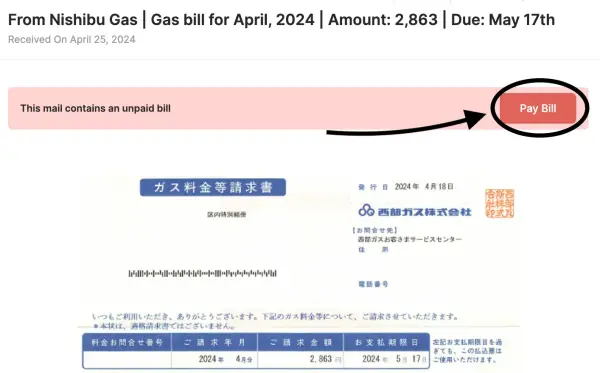
MailMate's services allow you to overcome this hurdle by letting you pay your bills abroad. Your bills will be forwarded to MailMate's scanning location, which will be uploaded to your dashboard so you can pay online.
A La Carte Services
MailMate has other additional services where you can request other services on your property, such as:
Fire and Disaster Insurance
Internet connection
Septic tanks contract
Solar panel setup and maintenance
Regular cleaning
4. Obtain a minpaku license (optional)
You can turn a cheap house into a short-term rental. To do so, file a minpaku notification (todokede, 届出) under the 2018 Private Lodging Business Act. Our minpaku license guide explains the process.
Minpaku rentals are subject to a 180-night yearly cap, and some cities set lower limits. To rent all year, you need a ryokan business license, the same license most minshuku run under. See Japan’s Airbnb law for the details.
A minpaku is a weak route to a Business Manager visa. The October 2025 rules require ¥30 million in capital, an office, and a full-time employee. Jiji Press also reported that outsourcing businesses, including those involving minpaku, no longer qualify.
Hidden costs of buying a cheap house in Japan
The asking price is often the smallest part of what you spend. Here is what a ¥500,000 rural akiya can really cost. Figures are estimates for October 2026, at about ¥158 per USD.
Worked example: the real cost of a ¥500,000 akiya
Cost item |
Estimate (JPY) |
About (USD) |
Notes |
|---|---|---|---|
Purchase price |
¥500,000 |
$3,200 |
Asking price |
Agent fee |
up to ¥330,000 |
up to $2,100 |
Cap for houses at ¥8M or less, since 1 July 2024 |
Judicial scrivener fee |
¥50,000–150,000 |
$320–950 |
Registers ownership (shiho shoshi, 司法書士) |
Registration and acquisition taxes |
Varies |
Varies |
Based on the assessed value; often low for rural akiya |
Stamp tax |
¥200 |
about $1 |
Reduced rate for contracts up to ¥500,000, until 31 March 2027 |
Home inspection |
¥50,000–100,000 |
$320–630 |
jutaku shindan (住宅診断); about ¥50,000–70,000 for a basic check |
Upfront, before renovating |
about ¥0.93M–1.08M plus taxes |
about $5,900–6,800 |
About double the asking price |
Renovation |
¥3M–10M (¥15M+ for full structural work) |
$19,000–63,000+ |
Roof, plumbing, wiring, termites, quake retrofit |
Yearly holding costs |
Varies |
Varies |
Fixed asset tax is 1.4% of the taxable base, with none below ¥300,000 (land) or ¥200,000 (building). Add insurance, utilities, and upkeep. |
What drives renovation cost
Houses built before June 1981 predate Japan's current seismic standard and may need earthquake retrofitting.
Roof leaks, termites, and mold add cost fast.
Rural homes may need a new septic tank or sewer connection.
See house renovation in Japan for finding contractors. Many towns offer renovation subsidies for akiya bank properties, so ask the town hall before you buy.
Do not leave the house unmanaged
Since 13 December 2023, towns can warn owners of neglected vacant homes, called kanri fuzen akiya (管理不全空家). A formal warning removes the land’s housing tax break. The land tax can then rise up to six times. Regular checks, mail handling, and repairs keep your house off that list.
Extra steps for overseas buyers
Appoint a tax representative (nozei kanrinin, 納税管理人).
File a report (Form 22) with the Minister of Finance, through the Bank of Japan, within 20 days. Since 1 April 2026, this applies to every house a non-resident buys, even at ¥0. The form is in Japanese, so most buyers use a Japan-resident agent.
Since 5 October 2026, declare your nationality when you register ownership. It does not appear on the public register.
Non-resident status depends on where you live, not your nationality. Japanese citizens abroad file too.
Locations to consider when looking for cheap houses in Japan
There are many akiya houses for sale in Japan. Below are the places foreign buyers ask about most, from Tokyo to the countryside.
Tokyo

Tokyo Metropolis stretches west into the rural Tama area.
Cheap houses in central Tokyo are rare. Few akiya for sale in Tokyo sit inside the 23 wards, and prices rise fast near the city center.
Your best chance is western Tokyo, in the Tama area. Areas such as Ome, Akiruno, Hinohara, and Okutama are part of Tokyo but feel rural. Okutama is about two hours from Shinjuku by train.
Outside Tokyo, buyers also look at:
The Chichibu area of Saitama
Yamanashi, near Mt. Fuji
Tochigi, including Nikko
Shizuoka, on the Tokaido Shinkansen line
These houses can cost more than a typical rural akiya, but you trade price for access.
Near Osaka and Kyoto
Western Japan can be cheaper than Tokyo at a similar distance. Akiya Japan’s listings show that commuter towns 60 to 90 minutes from Osaka often have family houses under ¥10 million. Rural parts of Kyoto Prefecture also have akiya, though central Kyoto stays expensive.
Countryside

The countryside, or inaka, has the most cheap houses in Japan. Popular rural areas for foreign buyers include:
Hokkaido, which lost 239,000 residents from 2020 to 2025, the biggest drop of any prefecture
Akita and Iwate in Tohoku
Fukui and Gifu in central Japan
Tokushima on Shikoku
Miyazaki in Kyushu
Each has regional cities with hospitals, train stations, and supermarkets. Some towns even pay people to move there; see will Japan pay you to move there?
Many countryside homes keep traditional floor plans with tatami rooms. For old farmhouses, read our guide to kominka. For daily life, see living in the Japanese countryside.
Okinawa

Okinawa is one of only two prefectures, with Tokyo, that grew from 2020 to 2025. That demand keeps prices higher than in rural areas on the mainland. It also had Japan’s second-lowest vacancy rate in 2023, at 9.4%, after Saitama.
Most Okinawan houses use concrete to resist typhoons and humidity. They often have flat roofs, while older homes use red roof tiles. Many show Ryukyu influences: wide rooms, outdoor spaces, and a pair of shisa guardians.
Cheap houses in Japan frequently asked questions
Is it true you can buy a house in Japan for $500?
Yes. Some akiya list for $500 or even for free on akiya banks and through town programs. But the price is only a small part of the cost. Agent fees can reach ¥330,000, and renovating often costs ¥3 million to ¥10 million. Budget for at least double the asking price before any renovation.
Can you buy a house in Japan for $30,000?
Yes, many houses in Japan list for under $30,000. As of 18 September 2026, Akiya Japan listed 16,094 houses under $50,000, with a median asking price of ¥3,900,000 (about $25,000). Most are older houses in rural areas, built between 1956 and 1990. Expect to spend more on renovating.
What are the hidden costs of buying a cheap house in Japan?
The biggest hidden costs are agent fees, renovation, and yearly upkeep. On a ¥500,000 akiya, upfront costs reach about ¥0.93 million to ¥1.08 million plus taxes before any work. That includes an agent fee of up to ¥330,000, a judicial scrivener (shiho shoshi, 司法書士) fee, and a home inspection. Renovation adds ¥3 million to ¥10 million. Yearly taxes are often low on rural akiya, but insurance, utilities, and upkeep add up.
Can foreigners buy houses in Japan?
Yes. Japan places no citizenship, visa, or residency limits on buying property. Since 5 October 2026, every new owner, Japanese or foreign, declares their nationality when registering ownership. In special monitoring zones, mostly within about 1 km of key defense sites, both buyer and seller must notify the Cabinet Office before signing if the land or building is 200 square meters or more. Non-residents must also report the purchase to the Minister of Finance through the Bank of Japan within 20 days. You do not need to speak Japanese, but a bilingual agent makes buying much easier.
Can I live in Japan if I buy a cheap house?
Not automatically. Owning a house in Japan does not give you a visa or residence status. You need a separate visa, such as permanent residence, a spouse visa, or a work visa. Since 16 October 2025, the Business Manager visa requires 30 million yen in capital and at least one full-time employee, and a minpaku run by an outside manager is unlikely to qualify.
Where are the cheapest houses in Japan?
The cheapest houses in Japan are in rural prefectures that are losing people. These include Hokkaido, Akita, Iwate, Fukui, Tokushima, and Miyazaki. Listings there can start below ¥500,000. Western Tokyo and commuter towns near Osaka cost more but offer better train access.
Why are old houses in Japan so cheap?
Old houses in Japan are cheap because their buildings lose value fast. Tax rules give wooden houses a useful life of 22 years, after which banks rarely lend against them. At the same time, the population fell to 123,049,524 in the preliminary 2025 Census. Japan now has about 9 million akiya, or 13.8% of all homes, according to the 2023 Housing and Land Survey.
Can I turn a cheap house in Japan into an Airbnb?
Yes, by filing a minpaku notification (todokede, 届出) under the 2018 Private Lodging Business Act. Minpaku rentals can run up to 180 nights a year, and some cities set lower limits. To rent all year, you need a ryokan business license. A minpaku run by an outside manager is unlikely to qualify you for a Business Manager visa.
In closing
Cheap houses in Japan are real, but a good deal starts with the full cost, not the asking price. Budget for fees, renovating, and yearly costs before you buy.
Start with two or three listing sites and subscribe to their email newsletters. Then visit, inspect, and read every detail before you sign. With patience, you can turn a cheap akiya into your dream home in Japan.
Spending too long figuring out your Japanese mail?
Virtual mail + translation services start at 3800 per month. 30-day money-back guarantee.