


Health Insurance in Japan for Foreigners (2026 Guide)


While Japan boasts a world-class healthcare system, navigating the health insurance system in Japan can be a challenge for foreigners.
In this article, we will explore the various health insurance options available to foreigners in Japan, including what they cover, how much they cost, and how to pay the insurance premiums.
Let’s get started.
Health insurance in Japan for foreigners (quick answer)
If you live in Japan for more than three months, you are legally required to enroll in public health insurance, regardless of nationality.
Most foreigners will be covered by one of the following:
Employees’ Health Insurance (EHI)—for full-time employees working for Japanese companies
National Health Insurance (NHI)—for self-employed individuals, students, freelancers, dependents, and those not enrolled in EHI
Japan’s public health insurance typically covers around 70% of medical costs, with patients paying the remaining 30% at the clinic or hospital. Coverage applies nationwide at licensed medical institutions.
Tourists and short-term visitors are not eligible for Japan’s public health insurance and should purchase private travel medical insurance before arrival.
Private health insurance in Japan is optional, not mandatory, and is usually used to supplement public coverage rather than replace it.
Which health insurance do foreigners need in Japan? (by visa status)
The type of health insurance you need in Japan depends primarily on your visa status and employment situation.
Below is a general guide for foreigners living in Japan for more than three months:
Visa status |
Required/typical insurance |
Key notes |
Work visa (full-time employee) |
Employees’ Health Insurance (EHI) |
Enrollment is usually handled by the employer. Premiums are shared between employer and employee. |
Work visa (part-time or contract) |
EHI or NHI |
Eligibility for EHI depends on working hours, contract length, and company size. Otherwise, NHI applies. |
Student visa |
National Health Insurance (NHI) |
Students often qualify for reduced premiums due to low income. |
Dependent visa |
EHI (as a dependent) or NHI |
If income is below the threshold, dependents may be covered under EHI. Otherwise, NHI is required. |
Permanent resident/spouse of Japanese national |
EHI or NHI |
Same public insurance options and obligations as Japanese nationals. |
Business manager / self-employed |
National Health Insurance (NHI) |
Required unless enrolled in EHI through a company. |
Tourist/short-term visitor |
Not eligible |
Public health insurance does not apply. Private travel insurance is strongly recommended. |
Important: Health insurance rules and premium calculations can vary by municipality, employment conditions, and income level. Local city offices can confirm which plan applies to your situation.
EHI vs. NHI: What’s the difference?
Japan’s public health insurance system has two main options for residents, including foreigners: Employees’ Health Insurance (EHI) and National Health Insurance (NHI). Which one applies depends on your employment status.
Category |
Employees’ Health Insurance (EHI) |
National Health Insurance (NHI) |
Who it’s for |
Full-time employees and eligible part-time/contract workers |
Self-employed, freelancers, students, dependents, unemployed |
How you enroll |
Employer enrolls you |
You enroll at your local city/ward office |
Premiums |
~9–10% of salary, split 50/50 with employer |
Based on previous year’s income and municipality |
How you pay |
Automatically deducted from salary |
Paid directly (monthly or in installments) |
Coverage |
~70% of approved medical costs |
~70% of approved medical costs |
Extra benefits |
Sick leave and maternity allowances |
No wage-replacement benefits |
Dependents |
Often covered at no extra cost if income is low |
Each person needs separate enrollment |
Which one is cheaper?
EHI is often more cost-effective for salaried workers due to employer cost-sharing and added benefits.
NHI costs vary widely and can be higher for higher earners or households with multiple members.
Eligibility criteria
Foreigners must have a residence card and a visa period of more than three months to be eligible for National Health Insurance. This applies from the date you register your address, not after you have already lived in Japan for three months. You must also not be eligible for Employees Health Insurance or any other public health insurance program in Japan.
Enrollment process
If you are interested in enrolling in Japan's National Health Insurance program, here's what to know:
a. Required documentation
Foreigners must provide certain documents to enroll in Japan's National Health Insurance program. These include a residence card and a passport. If you already have a My Number Card, bring that too. For those who are employed, a certificate of employment is also required.
b. Steps to enroll
The enrollment process for NHI starts at your local city office. Visit the national health insurance division and submit your required documents.
If you are new to Japan, bring your residence card and passport. In most cases, staff will process your enrollment on the same visit.
Japan stopped issuing paper health insurance cards in December 2024. If you have a My Number Card, you can register it as your health insurance card at the city office or at a convenience store kiosk.
If you do not have a My Number Card yet, the city office will give you a Certificate of Eligibility instead. This works the same as a health insurance card.
You will need this card or certificate for medical treatment at any hospital or clinic in Japan. Present it before your first visit.
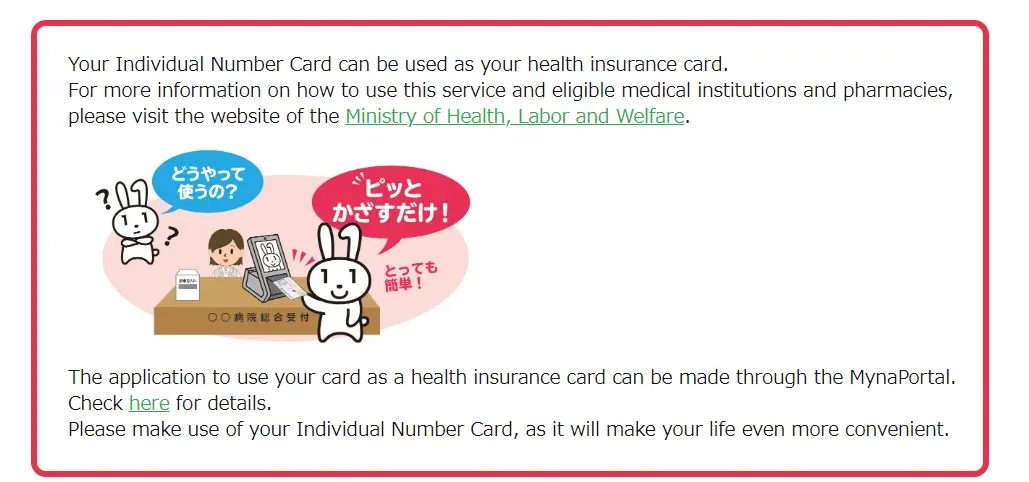
My Number Card is now the standard health insurance card for residents in Japan.
Switching from National Health Insurance when you start a job
If you get a job with employee insurance, you will switch from national health insurance to company coverage.
In most cases, your employer enrolls you in company insurance automatically. You do not need to apply yourself.
However, you still have a responsibility to close out your national health insurance. Visit your city office within 14 days of starting company coverage.
Bring your national health insurance card and your certificate of insurance eligibility from your new employer. The city office will process your withdrawal.
If you do not withdraw, you may be billed for both types of insurance at once. You could also be asked to repay medical costs covered by national health insurance after your company coverage started.
If you leave your job later, the process works in reverse. You will need to enroll in national health insurance again, unless you join another qualifying employer.
If you move or leave Japan
If you move to a different city, you must handle national health insurance at both offices.
Visit your old city office to withdraw and settle any premiums owed. Then visit your new city office to enroll and get a new card or certificate.
If you leave Japan permanently, you must return your insurance card or certificate to your city office. You also need to settle any unpaid premiums before you go.
Skipping this step can mean you keep getting billed for national health insurance after you leave. It can also cause problems if you return to Japan later.
Coverage and benefits
If you have enrolled in NHI, here's what to know about coverage.
General coverage
The National Health Insurance (NHI) program covers various medical services, including hospital stays, surgeries, dental appointments, and prescription medication.
However, it does not cover everything. For this reason, some foreigners choose additional or supplemental insurance.
Medical services not covered by NHI
NHI generally does not cover:
Cosmetic or elective procedures (e.g., aesthetic surgery, non-medical dermatology)
Advanced or experimental treatments not approved under Japan’s public system (自由診療)
Certain advanced treatments known as 先進医療, even when the base treatment is still insured
Routine health checkups, medical certificates, or preventive screenings
Private hospital rooms or upgraded accommodation
Certain dental and orthodontic treatments
Some fertility treatments and non-medically required procedures
Treatment received outside Japan
In these cases, patients must pay 100% of the cost out of pocket unless they have private insurance.
The NHI program is funded by the government and the individuals enrolled in the program, with the cost of premiums based on income.
Under the NHI program, foreigners can receive medical treatment at any medical facility in Japan. However, some medical facilities may not have English-speaking staff, making communication difficult for non-Japanese speakers.

Please refer to our guide on English-speaking hospitals in Tokyo.
Additional coverage options
If you already live in Japan and want coverage beyond national health insurance, the options below are for you.
Common reasons to apply for private insurance include:
Lump-sum payouts during hospitalization or surgery
Overseas medical coverage and emergency evacuation
Financial protection for services excluded from NHI
Some employers also offer employer-sponsored health insurance plans, which may provide additional coverage options beyond what is covered by the NHI program.
Foreigners living in Japan who plan to travel outside of Japan may also consider purchasing travel health insurance.
This type of insurance can provide coverage for medical treatment while abroad and emergency medical evacuation if necessary.
Important: Private insurance does not exempt residents from enrolling in NHI or EHI if they are eligible. Public health insurance enrollment remains mandatory under Japanese law.
See also: English-Friendly Insurance for Emergencies in Japan
Private and international insurance options
If you want coverage beyond national health insurance, several providers serve foreigners in Japan.
Private supplemental plans in Japan typically start around 3,000 yen a month for basic coverage. Comprehensive international plans with dental and vision can run up to 15,000 yen a month or more.
Provider |
Best for |
Key benefits |
Note |
AXA |
Foreigners wanting tiered options |
Five plan levels from basic to premium, dental on Standard tier and above |
Waiting periods apply to some add-ons |
Cigna Global |
Flexible, customizable coverage |
Silver, Gold, and Platinum tiers, strong mental health support |
Popular with long-term expats |
GeoBlue |
Americans splitting time between Japan and the US |
Access to the Blue Cross Blue Shield network in the US |
Best suited to US citizens |
Allianz Care |
Large global provider network |
Over 1.9 million medical providers worldwide |
Dental and maternity often sold as add-ons |
Pacific Prime |
Comparing multiple providers at once |
Insurance broker, not an insurer, offers quotes across companies |
Useful if you are unsure which provider fits |
Each provider has different waiting periods for maternity and dental coverage. Waiting periods can range from 6 months to 2 years, depending on the plan.
Travel insurance for tourists and short-term visitors
Tourists and short-term visitors cannot use Japan's public health insurance. Travel health insurance is essential, since medical care in Japan can be expensive without coverage.
Many hospitals accept credit cards, but many smaller clinics and dental offices are cash only. Carrying enough yen for a clinic visit is a good backup plan.
One example of travel insurance made for visitors is the TOKIO OMOTENASHI POLICY from Tokio Marine and Nichido. It can be purchased online before or shortly after arrival.
This type of policy covers sudden illness or injury for up to 31 days. Coverage can reach up to 10 million yen for treatment, medicine, hospitalization, surgery, and transportation home if needed.
If you contact the insurance company before going to the hospital, they can pay the hospital directly. This removes the need to pay the full bill yourself and wait for reimbursement.
Policies built specifically for illness and injury, like this one, are often priced lower than general overseas travel insurance. Coverage can also extend to sports injuries or other activity injuries, though high risk activities may be excluded.
If you are visiting Japan, buy travel insurance before your trip. It is one of the simplest ways to avoid a large, unexpected bill.
Health insurance premiums: cost and payment
How much does health insurance in Japan cost for foreigners?
The cost of health insurance in Japan depends on your income, age, municipality, and the type of public insurance you are enrolled in. While exact amounts vary, most foreigners fall within the ranges below.
National Health Insurance (NHI) costs
Premiums are calculated by your local municipality based on your previous year’s income
Most foreigners pay approximately 10,000 to 65,000 yen per month, depending heavily on income, age, and municipality
Students and low-income residents often qualify for reduced premiums
Premiums are paid directly by the individual (monthly or in installments)
National Health Insurance premiums are billed per household, not per person.
If anyone in your household is enrolled in national health insurance, the head of household receives the bill. This applies even if the head of household has separate insurance through a company.
Each household member still needs to complete their own enrollment. The premium itself is calculated once for the whole household and sent as one bill.
Employees’ Health Insurance (EHI) costs
Total premiums are usually around 9–10% of your gross salary
The cost is split equally between employer and employee
Enrollment and payroll deductions are handled by the employer
EHI includes additional benefits such as sick leave allowances and maternity benefits
Out-of-pocket medical costs (copay)
Public health insurance generally covers about 70% of approved medical expenses
Patients typically pay 30% at the clinic or hospital
Monthly caps apply for high medical expenses, which can significantly reduce costs in serious or long-term cases
Children, seniors, and low-income residents may pay less than 30%, depending on eligibility
Additionally, Japan has a system called the High-Cost Medical Expense Benefit. If your treatment in one month costs a large amount, this system caps what you pay:
For a typical earner, the cap is around 80,100 yen plus 1 percent of costs over 267,000 yen that month
For lower income residents, the cap is a flat 57,600 yen a month
This applies to major surgery, long hospital stays, and other costly treatment
You can apply for a certificate in advance so the hospital charges you only up to the cap
Private health insurance costs (optional)
Private insurance premiums vary widely depending on coverage and provider
These plans are typically used to supplement, not replace, public insurance
Common reasons for private insurance include lump-sum hospitalization payouts or overseas coverage
Important: Premium rates and reduction programs differ by municipality and may change annually. Your city or ward office can provide the most accurate calculation for your situation.
How are premiums calculated?
The cost of health insurance in Japan is based on an individual's income. The National Health Insurance (NHI) premium is calculated based on the previous year's income tax return.
The premium is usually paid monthly, and it is determined by multiplying the standard monthly premium rate by the individual's income. The standard monthly premium rate is adjusted annually.
For example, a single person earning 4 million yen a year often pays somewhere between 50,000 and 68,000 yen a month in Tokyo. Costs are usually lower in other parts of Japan.
Your age, household size, and municipality all affect the final amount. If this is your first year in Japan and you had no income here the previous year, your first bill may be much lower than this example.
Private health insurance premiums are usually higher than NHI premiums and can vary depending on the type of coverage and the insurance company.
How do I pay for my health insurance premiums in Japan?
Most city offices send the annual premium notice in mid June. The exact date can vary a little by municipality.
This notice covers a full year of premiums, split into 10 monthly payments from June through the following March.
If you enroll partway through the year, your first notice may arrive later and cover fewer months.
The National Health Insurance premium can be paid in a variety of ways, including at convenience stores, banks, or through automatic bank transfers.
It is important to note that the individual is responsible for paying the premium, and failure to pay can result in the suspension of coverage.
👉 How to Pay National Health Insurance in Japan
👉Forgot to Pay Japan NHI? Here’s What Happens
Starting in 2027, unpaid premiums can affect your visa
In June 2027, unpaid national health insurance premiums can affect your visa renewal.
Japan's Ministry of Health, Labour and Welfare announced this change on November 4, 2025. Health Minister Kenichiro Ueno confirmed the plan at a press conference that day.
A government survey found only 63 percent of foreign NHI members had paid in full by the end of 2024. The Ministry cited this figure as one reason for the new rule.
You can read the Ministry's own announcement on its website (in Japanese). Source: Ministry of Health, Labour and Welfare, November 4, 2025 press briefing.
Under the new system, immigration officials will work with city offices to close that gap. If you have unpaid premiums and have not responded to notification requests, your visa renewal or status change may be denied.
Having some unpaid premiums will not automatically trigger a denial. Officials will look at the full picture, including how much you owe and whether you are on a payment plan.
Here is what this means for you.
If you are not enrolled in national health insurance, enroll now at your city office
If you have missed payments, contact your city office and ask about a payment plan
If you are unsure of your enrollment status, bring your residence card to the national health insurance division and ask them to check
This rule applies to anyone staying in Japan for more than three months, regardless of nationality or visa type.
The safest move is to stay current on your premiums well before your next visa renewal.
👉 Read our guide to Japan Immigration News.
Frequently asked questions
What is Japan’s public health insurance program?
Japan’s public health insurance program is a universal system that ensures all legal residents have access to affordable medical care. It consists primarily of National Health Insurance (NHI) and Employees’ Health Insurance (EHI). Under this system, insurance typically covers about 70% of approved medical expenses related to injury and illness, with patients paying the remaining portion as hospital fees at the time of treatment.
How do foreigners enroll in the public health insurance program?
Foreign residents staying in Japan for more than three months must enroll in the public health insurance program. Enrollment is handled either by an employer (for EHI) or at the local city office through the national health insurance division for NHI. Required documents usually include a residence card and passport.
What is a health insurance card, and how is it used?
A health insurance card proves your enrollment in Japan's public health insurance program. Since December 2024, this is your My Number Card registered for insurance, or a Certificate of Eligibility if you don't have one set up yet. You must present it at your first visit to a hospital, clinic, or pharmacy. Without it, you may need to pay hospital fees in full and seek reimbursement later.
What medical costs are covered under public health insurance?
Japan’s public health insurance program covers medically necessary treatment for injury and illness, including doctor visits, hospital care, surgery, prescription medication, and most dental treatment. Patients generally pay about 30% of hospital fees, while the remaining cost is covered by insurance.
Are hospital fees the same everywhere in Japan?
Hospital fees under Japan’s public health insurance program are standardized nationwide for insured treatment. This means costs for treating the same injury or illness are generally consistent across hospitals, although fees may increase for private rooms or uninsured services.
Do I need to report changes to my city office?
Yes. Changes such as moving to a new address, changing employment status, or leaving Japan must be reported to your city office or employer. These updates ensure your enrollment in the public health insurance program remains accurate and uninterrupted.
How can international students enroll in the National Health Insurance in Japan?
Foreign students who plan to stay in Japan for over three months can enroll in the National Health Insurance program. They can apply for it at their local municipal office by presenting their residence card and a school enrollment certificate. The premium for National Health Insurance is based on the previous year's income, so students with low income may pay a lower premium.
What are the different types of health insurance available to foreigners in Japan?
Foreigners in Japan can choose between National Health Insurance and private health insurance. National Health Insurance is mandatory for all residents in Japan, including foreigners who plan to stay for more than three months. Private health insurance is optional but can provide additional coverage for medical expenses that National Health Insurance does not cover.
How is the National Health Insurance premium calculated for foreigners living in Japan?
The premium is based on your previous year's income, minus a basic deduction, multiplied by a rate your municipality sets. A separate flat charge is added per household member. For example, a single person earning 4 million yen a year often pays between 50,000 and 68,000 yen a month in Tokyo, though this varies by age and location. The bill is calculated once per household and sent to the head of household, even if other members have separate income.
What is the average cost of health insurance for foreigners in Japan?
National Health Insurance commonly runs from 10,000 yen a month for low earners to 65,000 yen or more for mid to high earners, based on income, age, and municipality. Employees Health Insurance costs around 9 to 10 percent of gross salary, split with your employer. Private supplemental plans start around 3,000 yen a month, and comprehensive international plans can run up to 15,000 yen a month or more.
Are tourists eligible for any form of health insurance while visiting Japan?
Tourists are not eligible for National Health Insurance. Instead, they can buy travel insurance made for visitors, such as the TOKIO OMOTENASHI POLICY, which covers up to 10 million yen for treatment, medicine, and transportation home. See the "Travel insurance for tourists and short-term visitors" section above for full details.
What are the consequences for foreigners who fail to pay their health insurance premiums in Japan?
Foreigners who fail to pay their health insurance premiums in Japan may face penalties, such as suspension of coverage or fines. If they fail to pay, their coverage may be canceled, and they may be required to pay the total cost of medical treatment out of pocket.
Will unpaid health insurance premiums affect my visa renewal?
Yes, starting in June 2027. If you have unpaid national health insurance premiums and have not responded to payment notifications, your visa renewal or status change may be denied. This applies to anyone in Japan for more than three months, regardless of nationality.
What is the High-Cost Medical Expense Benefit?
This is a system that caps your out-of-pocket medical costs in a single month. For a typical earner, the cap is around 80,100 yen plus 1 percent of costs over 267,000 yen. Lower income residents pay a flat 57,600 yen. It applies to both national health insurance and company insurance members.
Do I need a My Number Card for health insurance in Japan?
No, you can still receive medical treatment without a My Number Card. Ask your city office or employer for a Certificate of Eligibility instead. This certificate is free and works the same as a health insurance card. You will need to renew it periodically, so check with your insurer for the exact renewal date. Getting a My Number Card registered for insurance removes the need for renewal. Most residents choose this option long term.
Does public health insurance cover childbirth in Japan?
Normal childbirth itself is not covered by public health insurance, but a lump sum allowance of about 420,000 yen is paid through your insurer to offset costs. This applies to members of both national health insurance and company insurance.
Can I reduce my national health insurance premium?
Yes. Reduction programs exist based on income, and filing a tax return, even with low or no income, is required to qualify. Contact your national health insurance division to check your eligibility.
What happens to national health insurance if a member passes away?
National Health Insurance pays a funeral expense benefit if an enrolled member passes away. The amount is commonly around 50,000 yen, though it can vary by municipality. The person who arranges the funeral applies for this payment at the city office.
What happens to my insurance when I turn 75?
At age 75, you move from national health insurance or company insurance into the Late Stage Medical Care System for the Elderly. This applies to everyone, including foreign residents. Your city office handles the switch automatically around your birthday.
In closing
In conclusion, obtaining health insurance in Japan is mandatory for all residents, including foreigners. National Health Insurance covers most medical treatment for injury and illness, though some services are excluded. Private insurance is available to cover the gaps, but it is not mandatory.
The cost of health insurance in Japan varies across plans and policies. Generally, 70% of the costs associated with healthcare services are covered, and the remaining 30% is the patient's financial responsibility. However, paying less than 30% is possible, depending on one's financial circumstances.
Spending too long figuring out your Japanese mail?
Virtual mail + translation services start at 3800 per month. 30-day money-back guarantee.