


Japanese House Construction: Akiya Renovation Costs and Methods in Japan

Buying property is a huge milestone for anyone. But if you have recently purchased an akiya or obtained a free house in Japan, you may want to prepare yourself for some renovation work.
Japanese house construction relies on traditional post-and-beam methods, stone foundations, and wood frames. Many akiya, or abandoned houses in Japan, still use these methods today.
As of 2023, Japan had 9 million vacant homes, a record 13.8% vacancy rate. Of those, 3.85 million are true akiya with no plans for rent or sale.
If you bought an akiya or a free house in Japan, renovation costs range from ¥2,000,000 for basic repairs to ¥40,000,000 or more for a full rebuild. This guide breaks down the real cost of a house renovation in Japan, the traditional construction methods behind older homes, and how to decide if renovation is worth it for your property.
How is a traditional Japanese house built?
Traditional Japanese house construction uses a wood frame, not solid walls, to carry the building's weight. This method is called mokuzou jikugumi kouhou (木造軸組工法), the wood post-and-beam method, and it remains Japan's most traditional house construction method.
Builders set columns on top of stone foundations instead of burying posts in the ground. This method is called ishibadate. It lets the frame flex slightly during an earthquake instead of cracking.
Because the frame carries the weight instead of the walls, this method gives homeowners high flexibility in room layout. Walls can move or come out entirely without weakening the structure.
Key elements of the traditional method:
Columns and frame: A grid of wood columns supports the roof. Walls fill the gaps between columns, but they carry little weight.
Foundation stones: Each column rests on its own stone, not a continuous concrete slab.
Bamboo and mud walls: Older homes build their walls from woven bamboo, plastered with mud on both sides for strength and insulation.
Raised floor design: Traditional homes design their floors tens of centimeters above ground level. This gap creates airflow underneath, which helps control moisture in Japan's humid climate.
Large roofs and deep eaves: Japanese roofs slope sharply so rainwater runs off quickly. Deep eaves keep that water away from the walls below.
Tatami rooms (和室): Many traditional homes include at least one washitsu, a tatami-floored room that functions as a living room and sometimes a bedroom.
Gate and boundary wall: Many older properties have a gate marking the property line, often built from wood or stone.
Japan also legislated wall construction as far back as 1919, when it became a legal requirement for wooden buildings in urban areas to enclose their columns inside the walls. That change reduced fire risk across the country.
Many akiya still stand on this frame-and-stone method. This matters for renovation, because a traditional frame can often be kept even during a major rebuild.
Modern builders use concrete foundations and engineered materials instead. Knowing which method your property uses affects your renovation cost and your earthquake risk.
Modern construction methods used in Japan today
Not every renovation project keeps the old wood frame. Many akiya renovations, and nearly all new builds, use modern methods instead.
The main methods builders use in Japan:
Wood frame construction (2x4 method): Imported from North America, this method uses framed wall panels instead of columns. It offers high airtightness and strong seismic resistance.
Reinforced concrete (RC construction): Used mainly for mid-rise and high-rise buildings, including many mansions in Tokyo and other cities. RC construction offers excellent fire resistance.
Prefabricated construction: Builders produce wall and floor parts in a factory, then assemble them on site. This method gives high construction precision and shortens the project timeline.
Base isolation (seismic isolation): This method places isolation devices between the foundation and the building itself. It's one of the most effective ways to reduce earthquake risk in a home.
Today's Japanese homes also lean heavily on energy-saving insulation technology. Builders use high-performance insulation materials to cut energy costs year-round.
Seismic design stays critical at every stage of Japanese housing technology, from material choice to final inspection. This focus is a direct result of the earthquake risk covered earlier in this guide.
Waterproofing matters just as much. Japan's climate makes rain protection a top priority in any construction project, whether it's a new build or an older frame getting new walls and a new roof.
Larger projects increasingly use BIM (Building Information Modeling), a technology that manages information from design through construction to long-term maintenance in one system. Most akiya renovations won't need BIM, but it's common on bigger jobs.
A typical project brings together an architect, a bank for financing, and a builder. Each plays a different part, and understanding their role helps you avoid delays.
An overview of Japan's abandoned houses (akiya)

Japan's vacancy rate has climbed for 20 straight years. In 2013, about 8.2 million homes stood vacant nationwide. That figure made up 13.5% of Japan's total housing stock.
The rate climbed to 13.6% in 2018. That year's survey confirmed 3.49 million true akiya, with about 1.01 million of those in poor physical condition.
By 2023, the vacancy rate hit a record 13.8%, with 9 million vacant homes total and 3.85 million true akiya. Researchers project the rate could reach 30% by 2033.
The main causes are a shrinking population, high property taxes, and heirs who don't want to inherit a house. Many of these homes sit in the countryside, far from Tokyo and other major cities.
As a result, these Japanese abandoned houses tend to be old, vacant, and unmanaged, leading to much-needed akiya renovations.
Japan's government responds to this crisis two ways. Some measures penalize owners who neglect their property. Others support owners who choose to renovate.
Are there any government incentives for akiyas?
In December 2023, Japan amended its Act on Special Measures Concerning Vacant Houses. This law is a penalty, not a subsidy.
It created a new category called a management-deficient vacant house (管理不全空き家). If a municipality flags your property under this law, you can lose your residential land tax break. Your property tax may rise up to six times the normal rate.
This law is a reason to renovate, not a reward for it. Separate from this national law, many municipalities offer their own subsidy programs.
Common municipal subsidy programs include:
Rent support: some cities offer up to ¥40,000 per month toward rent.
Repair subsidies (改修補助金): many towns cover a part of renovation costs, often up to ¥1,000,000 per house.
Long-Life Quality Housing Renovation subsidy: a national program that covers part of the cost of seismic, insulation, or durability upgrades, with a cap of ¥1,200,000 per house. It can often stack with a municipal subsidy for even greater savings.
Demolition subsidies: some municipalities help cover the cost of tearing down unsafe structures.
Every program has its own rules. Eligibility depends on the prefecture, the city, and the specific municipality where your property sits.
Japan passed its Vacant House Act in 2014, pushing local governments toward reuse instead of neglect. Many municipalities established their akiya bank listing services in direct response to this 2014 law. Others expanded programs that already existed.
Today, these akiya banks connect buyers directly with vacant properties across the country.
👉 Read also: Will Japan Pay You To Move There?
Why should you have an akiya house renovated?

There are three main reasons why people purchase akiya houses in Japan: to live in them, to use them as vacation homes, or to make investments in Japan's real estate market.
All three reasons require the akiya house to have a new life for its new function. As such, these properties will need reconstruction and renovation.
Depending on the property's age and deterioration, only renovations may be required, such as minor plumbing and electrical wiring vs reconstruction for a more earthquake-resistant building and better insulation.
Essential due diligence: What needs to be checked for an akiya house?

Traditional houses might have mold, termite damage, or structural issues in rural areas.
Be sure to have an inspector determine what needs to be repaired and learn the estimated costs for the needed repairs. Ask questions such as: Does it sit directly on the floor? Are the beams and frame in good shape? etc.
Why 1981 matters for any akiya purchase
In 1981, Japan strengthened its building code with a new seismic standard. Houses built before that year often lack modern earthquake protection.
Most akiya on the market today were built before this law. In fact, roughly three in four true akiya nationwide predate 1981.
Ask your inspector for the exact build year before you buy. A house built after 1981 already meets the newer, stricter earthquake standard. A house built before 1981 will likely need seismic reinforcement, which adds real cost to your renovation budget.
Here's a checklist to run through if you're considering purchasing an akiya:
Legal and administrative
Verify clear title ownership through local legal registry
Confirm property boundaries and any easements
Check zoning restrictions and building code compliance
Research any outstanding taxes or liens
Understand inheritance laws if the property was inherited
Verify utilities availability and connection costs
Physical inspection priorities
Foundation stability and structural integrity
Roof condition and water damage
Electrical system safety and capacity
Plumbing functionality and water quality
Septic system status (合併浄化槽), required if the property isn't connected to public sewage.
Insulation adequacy for local climate
Pest damage, particularly termites. A termite inspection (白蟻調査) before purchase can save you from a costly surprise.
Mold and moisture issues, common in Japan's humid climate.
Earthquake resistance compliance
Neighborhood considerations
Access to essential services (medical, grocery, emergency)
Public transportation availability
Internet connectivity options
Community acceptance of foreign residents
Local contractor and service provider availability
How much does it cost to renovate a house in Japan?
Project Type |
Typical Total Cost |
Timeline |
Scope of Work |
Basic Renovation in Japan |
¥2,000,000–¥5,000,000 |
2–4 months |
Essential repairs only (plumbing fixes, electrical safety, wall/floor replacement) |
Modern Comfort Renovation |
¥5,000,000–¥15,000,000 |
4–8 months |
Kitchen and bathroom upgrades, insulation, windows, HVAC |
Complete Reconstruction |
¥15,000,000–¥40,000,000+ |
8–18 months |
Structural overhaul, seismic reinforcement, architectural redesign |
New Construction (from scratch) |
¥30,000,000–¥60,000,000+ |
10–15 months |
Full custom build meeting modern building codes |
Costs also depend heavily on where your property sits in Japan.
Region |
Cost Impact |
Why |
Tokyo and Osaka metro |
Highest |
Labor is in high demand. Contractors charge a premium and book out months ahead. |
Regional cities (Fukuoka, Sendai, Niigata) |
Moderate |
Good contractor availability at reasonable labor rates. Often the best value. |
Deep countryside |
Lower labor, higher logistics |
Labor is cheaper, but fewer contractors mean longer waits. Material delivery to remote land adds cost. |
Level 1: Basic habitability (¥2,000,000-¥5,000,000)

Timeline: 2-4 months
Essential repairs to make property livable:
Wallpaper/flooring replacement: ¥800-¥1,200 per sqm
Basic kitchen functionality: ¥300,000-¥600,000
Bathroom renovation: ¥400,000-¥800,000
Electrical safety upgrades: ¥200,000-¥500,000
Plumbing repairs: ¥150,000-¥400,000
Pest treatment and prevention: ¥100,000-¥300,000
Result: Functional but basic living space, suitable for immediate occupancy but not modern amenities.
Level 2: Modern Comfort (¥5,000,000-¥15,000,000)

Timeline: 4-8 months
Comprehensive updates for contemporary living:
Complete kitchen renovation: ¥800,000-¥1,500,000
Full bathroom modernization: ¥1,200,000-¥2,000,000
HVAC system installation: ¥600,000-¥1,200,000
Insulation upgrade: ¥1,000,000-¥3,000,000
Window replacement: ¥500,000-¥1,200,000
Interior design and finishing: ¥1,000,000-¥2,500,000
Result: Comfortable modern home meeting current lifestyle expectations.
Level 3: Complete Reconstruction (¥15,000,000-¥40,000,000+)

Timeline: 8-18 months
Structural overhaul for maximum safety and comfort:
Foundation reinforcement: ¥2,000,000-¥5,000,000
Seismic retrofitting: ¥1,500,000-¥3,000,000
Roof replacement: ¥1,500,000-¥4,000,000
Complete rewiring and replumbing: ¥1,000,000-¥2,500,000
Architectural redesign: ¥2,000,000-¥5,000,000
High-end finishes and appliances: ¥3,000,000-¥8,000,000
Result: Essentially new home built within the existing structure.
Serious akiya house issues require major repairs, including foundation issues and installing earthquake-resistant materials.
Working with an architect or renovation firm helps you understand which construction method your house uses. They can also tell you which renovations fit your budget.
Your styling preference will also determine the methods for major reconstructions, such as whether you prefer a traditional Japanese house or a more Western style.
Depending on the size of the property, these major akiya repairs typically start at ¥15,000,000 and can run higher.
Note: These figures cover the core work only. Contingency, permits, and professional fees push the real total toward the top of this range.
A real akiya renovation, start to finish
Real numbers help more than ranges. Here's one real example, itemized in full.
The property: a 4,000,000 yen akiya near a regional city, structurally sound but outdated.
The costs:
Purchase price: ¥4,000,000
Closing costs (registration, tax, agent fee): ¥621,000
Kitchen and bathroom renovation: ¥2,300,000
Insulation and window replacement: ¥1,800,000
Utility reconnection: ¥400,000
Total investment: approximately ¥9,100,000
The result was a modern, livable home for under ¥10,000,000 total. That's still far below new construction cost in most of Japan.
A renovated akiya can also sell or rent for well above its pre-renovation value. The exact increase depends on location, but a well-renovated property in a regional city often recoups a meaningful part of the renovation cost.
Note: Every property is different. Your total will depend on the home's condition, its location, and the scope of your project.
What are some lesser-known renovation costs in Japan?
Regulatory and professional fees (10-15% of renovation budget)
Building permits and inspections: ¥200,000-¥800,000
Architect/structural engineer fees: ¥1,000,000-¥3,000,000
Legal and administrative costs: ¥300,000-¥600,000
Temporary living and storage (¥200,000-¥500,000)
Alternative accommodation during renovation
Furniture storage if property contains items
Transportation costs for remote properties
Utility connection fees (¥300,000-¥1,200,000)
Electricity: ¥50,000-¥200,000
Water/sewage: ¥100,000-¥500,000
Gas: ¥80,000-¥300,000
Internet/phone: ¥50,000-¥200,000
Is it worth it to renovate an akiya?
The answer to this question depends on how much renovation is needed. Some will be fine with a functional house with few cosmetic repairs, while others would like a complete Japanese house built from scratch.
Renovated Akiya. The Before and After by Asthmatic In JapanTalk with professionals such as inspectors, architects, and real estate agents about how to proceed accordingly.
Tips for Japanese house construction
Japanese house reconstruction for an akiya is different from how home reconstruction is done in America. To help save you time, effort, and money, here are 3 points to consider:
DIY vs. professionals: While taking on any project yourself will be cost-effective, hiring professionals ensures quality and can solve any upcoming problems.
Always prep: understanding the layout of your house, such as where pipes are, is crucial before any major repairs.
Wallpaper vs wall paint: In Japan, using wallpaper is more common than painting your walls. To paint your walls, you must prepare the surface by removing the vinyl.
How to use MailMate to help with akiya renovations
It might be hard to find someone who knows English in rural Japan, making the akiya renovation a little more difficult than it should be. That's why services like MailMate are here to help.
MailMate will call to help connect your property to gas, water, and other utilities. Additionally, MailMate can help with setting up the internet, cleaning, and land maintenance for a smooth akiya renovation.
Here's a quick run-through of MailMate's features for property owners:
a. Bilingual staff
MailMate's bilingual staff are fluent in Japanese and English and can serve as a trusted communication bridge between you and whichever Japanese service you need.
For example, if you need your water supply inspected, let MailMate know. We will contact the local company and have them visit and check the water quality.
b. Schedule maintenance and services

Keep your property up and running through MailMate's property management services, ideal for owners who want to manage their Japanese property from overseas.
MailMate helps owners with the following and more!
Utilities set up
Getting fire and disaster insurance
Setting and scheduling internet
Regular cleaning and yard work
MailMate will be your communication bridge by contacting the services on your behalf so you can sit back and relax.
c. Tax agent service
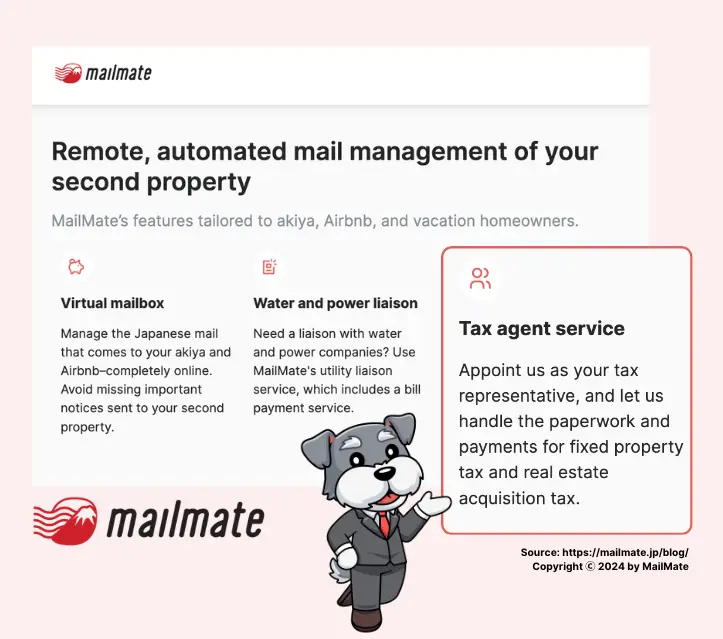
Once you own a property in Japan, you become responsible for property-related taxes. Paying Japanese tax bills can be difficult when you are not in Japan.
But don't worry. If you make MailMate your tax representative, they will help with the paperwork to ensure you and your property stay tax compliant.
Frequently asked questions
What happens if I find out there are legal issues with the property after purchase?
Always conduct thorough due diligence before purchase. If issues arise post-purchase, you may have legal recourse depending on disclosure requirements, but litigation in Japan can be expensive and lengthy. Title insurance isn't standard in Japan, making pre-purchase verification crucial.
How much should I budget beyond the stated renovation costs?
Plan for 130-150% of initial estimates. Cost overruns of 20-30% are common due to hidden structural issues, regulatory changes, or material price fluctuations. Additionally, budget for temporary accommodation, storage, utility connections, and professional fees that aren't always included in contractor quotes.
Are renovation loans available for akiya properties?
Japanese banks offer renovation loans, but approval depends on property condition and your residency status. Interest rates range from 1.5-4% for residents, with terms up to 35 years. Non-residents typically need cash or financing from their home country. Some municipalities offer low-interest loans as part of revitalization programs.
What is a management-deficient vacant house?
A management-deficient vacant house (管理不全空き家) is a category created under Japan's December 2023 law. It applies to properties showing early signs of neglect, like an overgrown yard or a damaged roof. If your municipality flags your property this way, you risk losing your residential land tax exemption, which can raise your property tax up to six times.
Do renovation costs differ between Tokyo and the countryside?
Yes. Tokyo and Osaka have the highest renovation costs because labor is in high demand and contractors charge a premium. Regional cities like Fukuoka and Sendai often offer the best value, with good contractors at reasonable rates. Deep countryside properties have lower labor costs but face higher costs for delivering materials to remote land.
Can I keep the traditional wood frame during a renovation?
Often, yes. Traditional Japanese house construction uses a wood column-and-beam frame set on stone foundations, not load-bearing walls. If the frame and foundation stones are structurally sound, many renovations keep them in place and rebuild the walls, insulation, and finishes around them. An architect or structural engineer should confirm the frame's condition first.
What should I check for termites and septic systems before buying?
Always request a termite inspection (白蟻調査) before you close on any akiya. Termite damage in humid regions of Japan can hide inside walls and beams. If the property isn't connected to public sewage, check the status of its septic system (合併浄化槽), since installing or upgrading one can add significant cost.
Are there real examples of what a full renovation costs?
Yes. One typical example: a ¥4,000,000 akiya near a regional city, with ¥621,000 in closing costs and roughly ¥4,500,000 in renovation costs for kitchen, bathroom, insulation, and utilities, for a total investment near ¥9,100,000. Your total will vary based on the property's condition and location.
In closing
Renovating an akiya house or doing a full Japanese house construction are options for rebuilding an akiya home.
Factors such as budget, functionality, and personal style affect how your house should look and function.
So, by weighing the costs and benefits, you can make an informed decision about rebuilding your akiya house.
花太多時間處理日本郵件?
虛擬郵箱 + 翻譯服務每月僅需 3800 元起。30 天退款保證。